Shopify vs. SFCC: The Battle for the Best Ecosystem!
Did you know that Shopify’s App Store boasts over 8,000 apps, while Salesforce Commerce Cloud (SFCC) offers a tightly curated selection of integrations? The battle between these two eCommerce giants is not just about platform capabilities—it’s about the strength of their ecosystems.
As businesses seek more extensible and scalable solutions, the availability and depth of third-party integrations play a crucial role in platform selection. Shopify and SFCC approach extensibility differently, each catering to distinct business needs and complexities.
This article compares the robustness of Shopify’s App Store and SFCC’s integration ecosystem, analyzing how each impacts feature extensibility and overall business growth.
Problem Overview
🧩 The Challenge of Feature Extensibility
No eCommerce platform is one-size-fits-all. Retailers often require additional functionalities, such as AI-driven recommendations, multi-channel selling, and advanced customer segmentation.
The challenge? Finding a platform that offers seamless third-party integrations without compromising performance or security.
⚙️ Shopify vs. SFCC: The Different Approaches
- Shopify offers an open, rapidly growing app marketplace with plug-and-play solutions for businesses of all sizes.
- SFCC provides a more curated, enterprise-focused integration approach with deep customization capabilities but fewer plug-and-play solutions.
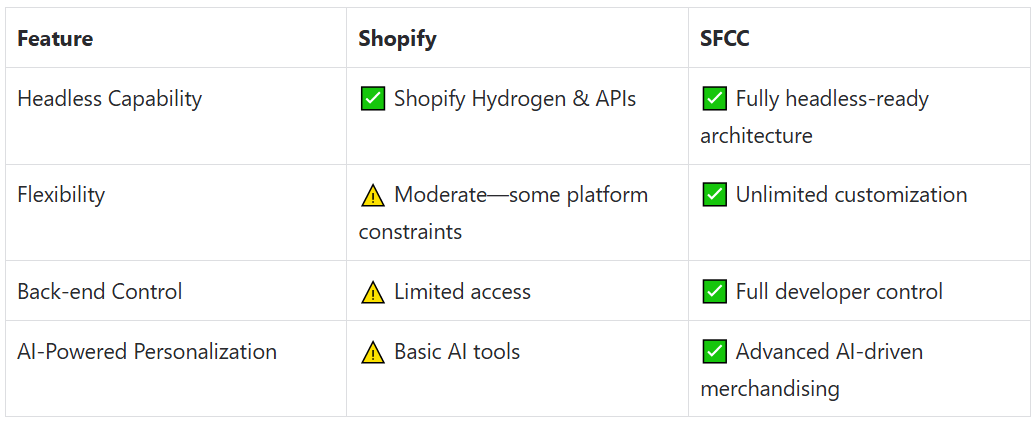
Shopify Apps vs. SFCC Integrations
Shopify’s App Ecosystem: An Open-Source Playground
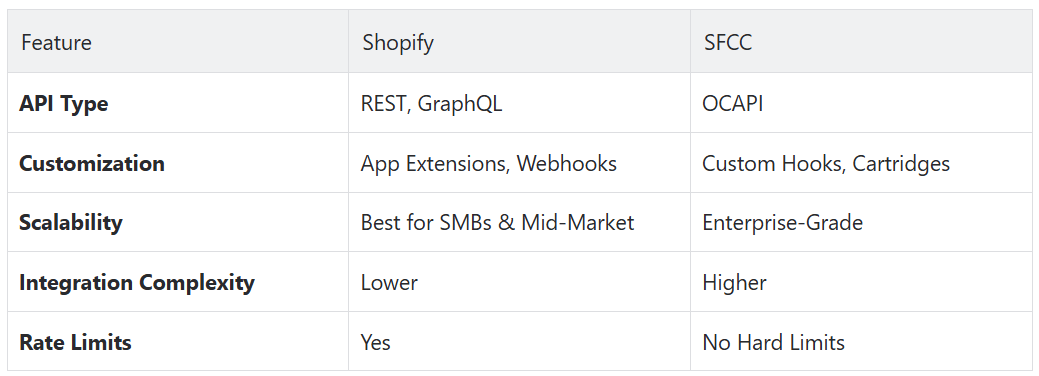
Shopify operates an open ecosystem where developers can create and monetize apps via the Shopify App Store. With 8,000+ apps, businesses can quickly extend their stores with tools for SEO, marketing automation, and omnichannel retailing.
SFCC’s Integration Model: Enterprise-Grade Customization
SFCC uses abstract classes to directly communicate with the database, providing fine-grained access to key store objects. It also supports third-party connectors, which are often custom-built and require developer expertise, enabling deep, enterprise-level customization.
Advantages
Why Shopify’s App Model Works
- Ease of Use: Businesses can install apps with one click, requiring minimal technical expertise.
- Diverse Solutions: Thousands of apps cater to every niche, from dropshipping to enterprise-level automation.
- Rapid Deployment: Merchants can test and deploy features instantly, reducing time to market.
Why SFCC’s Integration Model Works
- Deep Customization: Tailored integrations offer enterprise-grade scalability.
- Stronger Data Security: Controlled integrations reduce security risks compared to an open app marketplace.
- Seamless Cross-Cloud Integrations: Businesses using other Salesforce products (e.g., CRM, Marketing Cloud) benefit from a unified ecosystem.
Addressing Concerns
Shopify Apps: Are They Secure?
Many assume Shopify’s open marketplace leads to security risks. However, Shopify employs rigorous vetting to ensure app compliance.
SFCC: Is It Too Complex for Mid-Sized Businesses?
SFCC is mainly used for large businesses, but it also has ready-to-use tools that make it easier for mid-sized companies to get started.
Trends in eCommerce Extensibility
🤖 The Rise of AI-Powered Integrations
Both Shopify and Salesforce Commerce Cloud are enhancing their platforms with AI-driven tools.
Shopify offers “Shopify Magic” a suite of AI features including the Sidekick assistant, which helps merchants automate tasks like generating product descriptions and managing discounts.
Similarly, Salesforce Commerce Cloud integrates AI through its Einstein platform, providing personalized product recommendations and intelligent search capabilities to improve customer experiences.
🛒 The Shift Toward Headless Commerce
With headless commerce gaining traction, both platforms are investing in API-first architectures, allowing businesses to build fully customized eCommerce experiences.
Conclusion
- Shopify’s App Store offers an accessible, diverse ecosystem with quick deployment options.
- SFCC’s integration model prioritizes deep customization and enterprise scalability.
- Both platforms continue to evolve, focusing on AI, security, and API-first development.
*Which platform suits your business better—Shopify’s fast-growing app marketplace or SFCC’s tailored enterprise integrations?*
*Make the right choice for your business. Connect with our experts to get tailored guidance on which platform aligns with your goals.*